Physical model
Dust dynamical model
The dust dynamical model describes the dust distribution within a cometary coma up to 1000 nuclues radii (RN). It uses minimal number of parameters for the description of a cometary dust coma, while keeping it physically realistic. This model physically consistently takes into account the expanding nature and asymmetry of the gas coma (caused by gas production modulated by solar radiation) and considers the dust dynamics driven by the gas drag force, force from the nucleus gravity, and solar radiation pressure. A series of general assumptions were made to simplify the model. For each of the simplifications we have also outlined the resulting limitations that need to be appreciated.
-
The nucleus shape is assumed to be spherical. The dust dynamical model can therefore not reproduce possible inhomogeneities within the coma that arise due to topography (and often occurs only at particular orientation of the nucleus with respect to the Sun). Nevertheless, when the parameters of the coma of a complex shape nucleus are averaged over a full comet rotation the resulting average coma distribution resembles closely the one from a spherical nucleus.
-
The gas is assumed to be an ideal perfect gas. The gas flow in the coma is described by the gas-dynamic Euler equations which express the conservation of the mass, momentum and energy in the flow of an ideal perfect gas.
In other words these equations describe the motion of an equilibrium fluid flow without viscous dissipation and heat conductivity. The real atmosphere of a comet contains rarefied non-equilibrium regions as well.
The transfer of thermal energy into kinetic energy in a rarefied flow is less efficient than in a fluid flow, therefore the rarefied flow accelerates slower. Due to the presence of viscous dissipation flow structures like shocks are diffused in a rarefied flow.
Nevertheless, as was shown in many publications, the description of the flow based on the fluid equations preserves general physical realism of the flow.
An important merit of the Euler equations is that they don’t depend on the flow rarefaction and therefore the solutions can be scaled for different production rates, the main reason why we use them in the present model.
-
It is assumed that the dust does not influence the gas flow (i.e. no back-coupling of the dust to the gas flow). This allows the separate/sequential determination of the gas and dust flows. This is given for comets with low dust-to-gas ratios [~< 10]. Nevertheless, for a comet with a high dust-to-gas ratio the model will be able to produce reliable predictions.
-
It is assumed that the gas coma is constituted of one single species, H2O. This assumption will be reasonable well satisfied for comets where H2O is the dominant gas species (as e.g. for comet 67P).
-
It is assumed that there is no extended gas/dust source/sink in the coma. The model should not be applied to comets with a significant extended gas/dust source/sink e.g. emission of gas from dust particles within the coma, sublimation and destruction of dust particles etc.
-
It is assumed that the gas and dust emission is smooth across the surface or that any inhomogeneities are blurred within the drag acceleration region r<10RN. The gas and dust emission is modulated e.g. by solar zenith angle. It means that the emission is not dominated by a few very localised jets.
-
The model is reliable for cometo-centric distances of 10RN < r < 1000RN. The low limit is defined by the possible existence of ’fine structure’ of the flow due to particularities of the surface structure. The upper limit is defined by the size of computational region. It is possible to extrapolate the data beyond this upper limit via introducing additional assumptions (e.g. sphericity of expansion etc.).
-
The model is run for a heliocentric distance of 1 AU, the approximate distance of CI’s comet during the encounter. Result shall thus not be attempted to be scaled to vastly different heliocentric distances. The results remain valid for variations of the heliocentric distance that do not change the solar flux to the nucleus surface by more than a factor of 2 (i.e. the model is valid for the heliocentric distance range of CI).
-
It is assumed that dust particles are spherical, homogeneous with invariable size and mass.
For the underlying gas dynamics model we used the results by (Zakharov et al. Icarus 354, 2021) who have calculated the gas field by solving the Euler equations. The emission distribution at the surface is assumed to be proportional to cosα(zsun), where zsun is the solar zenith angle, and the power α takes the values 1, 2, and 3 (which corresponds to the different mechanisms of gas production from the nucleus). Nigh-side activity is introduced as uniform emission with respect to zsun and quantified by the ratio of the gas production rate at the anti-solar point to the production rate at the sub-solar point, qg(180°)/qg(0°).
The gas results are used to calculate the dynamics of spherical dust particles taking into account gas drag, nucleus gravity, and solar radiation pressure. An important implicit assumptions to reiterate is that we assume that the dust does not have a back reaction effect on the gas flow. The dust dynamics makes use of dimensionless variables (derived by combining various physical parameters) to parametrise the dust dynamics as described in (Zakharov et al. Icarus 312, 2018) and reduce the number of numerical solutions. The result of this step is the dust number density and velocity in 3D space. At this point there is also the implicit assumption that the dust-to-gas mass production rate ratio, χ, is unity. These solutions therefore do not yet have an absolute scale.
The reference frame:
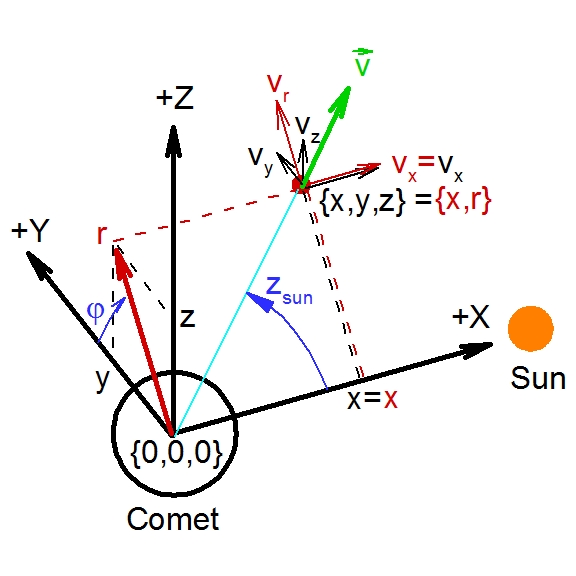
The model uses axially-symmetric frame {X,r} (with respect to the axis X). Axis +X is directed towards the Sun. The distance r is perpendicular to the axis X. The origin is in the center of the nucleus.The transformation of coordinates {x,y,z} in the cartesian frame (with X≡X) into the frame of the database is:
x = x,
r = (y2+z2)1/2.
The transformation from the frame {x,r} into cartesian {x,y,z} is:
x = x
y = r cos(φ)
z = r sin(φ)
vx= vx
vy= vr cos(φ)
vz = vr sin(φ)
where φ = acos(y/r) (if z≥0) or φ = 2π - acos(y/r) (if z<0).
References:
V. V. Zakharov, S. L. Ivanovski, J. F. Crifo, V. Della Corte, A. Rotundi, and M. Fulle, Asymptotics for spherical particle motion in a spherically expanding flow, Icarus 312, 121 (2018). https://doi.org/10.1016/j.icarus.2018.04.030
V.V. Zakharov, A.V. Rodionov, M. Fulle, S.L. Ivanovski, N.Y. Bykov, V. Della Corte, A. Rotundi, Practical relations for assessments of the gas coma parameters. Icarus 354 (2021) 114091. https://doi.org/10.1016/j.icarus.2020.114091
V.V. Zakharov, A. Rotundi, V. Della Corte, M. Fulle, S. L. Ivanovski, A. V. Rodionov, N.Y. Bykov On the similarity of dust flows in the inner coma of comets. Icarus 364 (2021) 114476 https://doi.org/10.1016/j.icarus.2021.114476
In case of issues or questions, please contact: vladimir.zakharov@obspm.fr